How the Laser Girls build a superhero
You stand on an X. You look at a screen. And looking back at you is you — but a superhero, moving when you move. Then you take home a printed photo that flips between the two of you when you tilt it. Here's the whole trick, no secrets kept.
The camera catches your light
Right now, light is bouncing off you in every direction — that's what "being visible" means. A camera is just a bucket for that bouncing light: a lens gathers it and an electronic sensor measures it, millions of tiny points at a time, about 30 times every second.
To the Laser Girls this is the most natural idea in the world. You are a light pattern, as far as they can see. The camera simply writes that pattern down. Real science
The sisters re-weave the pattern
Once your picture is a pattern of numbers, it can be re-woven. The computer finds your shape — where your face is, your shoulders, your hands — and redraws the pattern with a hero suit, a glow, a cape. Your movements stay yours; only the light gets restyled.
In our story, this is the sisters doing what they do best: untying a light pattern and re-knotting it into something new. Our story — the computer graphics doing it for real on the screen? Real science
The light mirror shows hero-you, live
The re-woven pattern is sent to a big screen faster than you can blink — the whole trip from camera to sisters to screen takes a few hundredths of a second. That's why it feels like a mirror: wave, and hero-you waves back right now.
A real mirror swaps left and right, so our screen flips the picture the same way. Raise your right hand and hero-you raises the hand on your right, exactly like the bathroom mirror does. Real science
Freeze! Two pictures become one magic print
When you strike your pose, we capture two pictures at once: plain you and hero you. Then comes the cleverest part. Both pictures are sliced into skinny strips — thinner than a hair — and shuffled together: you, hero, you, hero, you, hero…
On top goes a special plastic sheet covered in tiny curved ridges called lenticules — 60 of them per inch. Each ridge is a tiny lens that only lets each eye see one set of strips at a time. Real science
Tilt the card one way: all the "you" strips line up, and you see yourself. Tilt the other way: the "hero" strips take over. Flip, flip, flip — a superhero transformation you can hold in your hand, powered by nothing but geometry.
Try the numbers
Our prints use 60 lenses per inch and are built at 1200 dots per inch — so each lens covers exactly 20 dots, and each picture gets 10 dots per strip. A 4×6 inch print is a 4800×7200-dot mosaic of you-and-hero slices. Want to go deeper? The full lenticular explainer →
We did it to ourselves first
Every superhero needs an origin. Ours started with two real sisters, two suits of glowing wire, and one glowing orb — at Open Sauce, one year ago. Drag the beam of light across the picture to flip between the real Laser Girls and their story selves, Lumina and Spark. This is exactly what the flip-print in your hand does — just with a sheet of tiny lenses instead of a slider.

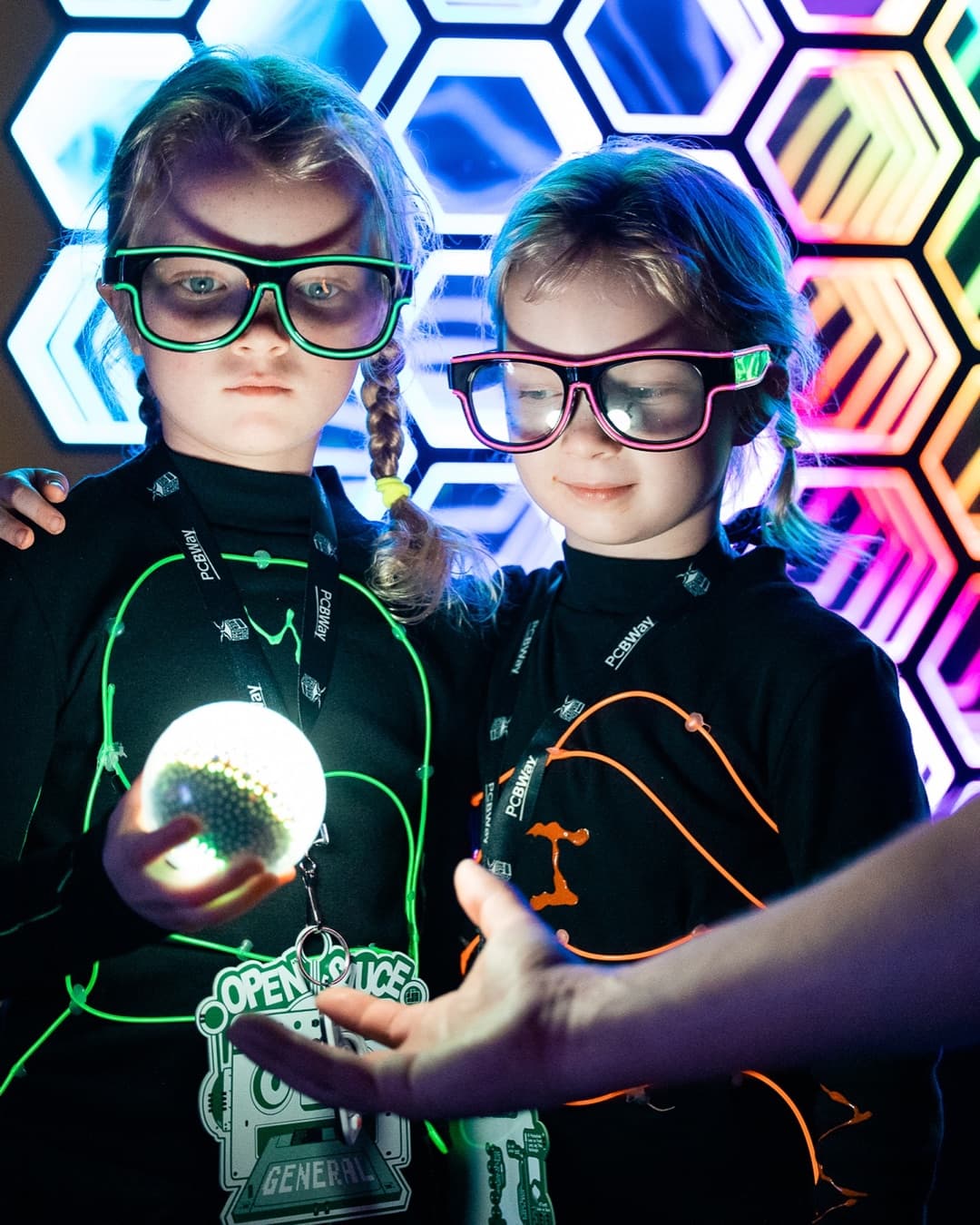
One card, two selves. That's the whole idea.
And if the word "superhero" makes you picture punching — ours are a new kind: no fists, no weapons, and one real superpower.